Am Samstag, den 10.12.2016 findet in der Zeit von 15-17 Uhr im und am Ratskeller in der Niederstraße der Weihnachtsbaumverkauf durch den Kerbejahrgang 1973 statt.
Hans Philipp Schmitt, Ortsbürgermeister
 |
Spiesheim/Rheinhessen |
 |
Tour of Spiesheim's History
Graveyard and Funerals
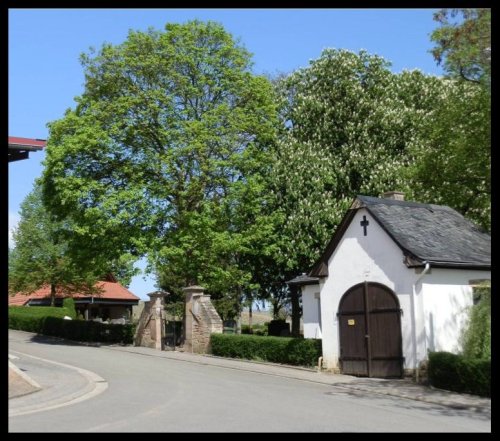
In many cultures, the graveyard with its graves as last resting place of the deceased is a space clearly separated from the world of the living. It enables the relatives to commemorate their deceased in peacefulness. In Germany, deceased and stillborn have to be buried at designated places.
The graveyard plays an important role in religious practice and meets public needs, too.
This social as well as religious significance of a graveyard has originated a variety of taboos, moral duties and laws. Offending the rules or desecrating the place is punished by the respective community. Disturbance of peace, desecration of corpses, defilement of graves and grave robbery are punishable in practically all cultures. Such actions are prosecuted in Germany.
During ancient times and the great migrations, the German tribes living in the territory of today's Germany cremated or buried their dead.
Cremation was prohibited with the spreading of Christianity. Following the history of Jesus Christ the faithful were buried. Only at the end of the 19th century cremations were allowed again.
In the Middle Ages, the burial of the deceased was very much characterised by the church. Usually, it took place on the day of death and under certain formalities that varied considerably depending on the status of the deceased: Ordinary people were buried without coffin, just lying on a board and given to earth in the clothes they had worn while dying. More distinguished people were buried in a coffin, sometimes made of stone until the 14th century. The deceased was carried to his grave by his relatives.
Medieval burial sites have not been preserved in Germany. Usually, and so in Spiesheim, too, they were situated round the Catholic Church, which is why another word for "graveyard - Friedhof" is "churchyard - Kirchhof" in German. Since the beginning of the 16th century, burial sites were moved to the outskirts of villages due to lack of space and danger of epidemic. This arrangement has been kept in many villages, which is also valid for the graveyard in Spiesheim opened in 1833.
From this time on, the deceased were put in a coffin in the house they had died and on the funeral day laid out on a bier in the yard. After the last blessing through the priest and possibly a farewell by the choir or band the coffin was put on the hearse. Decorated with flowers and wreaths, and, most of the time, accompanied by many mourners the funeral procession began to move. People from nearly every house "went with the procession". A horse covered with a black blanket drew the hearse to the graveyard.
Until the end of the late 1980s, the graves on the graveyard in Spiesheim were dug by hand, which was a very hard work, especially in winter when the soil was frozen.
Sliding soil caused by heavy rain often had to be removed from the grave. Sometimes the gravedigger was still looking out of the open grave when the funeral procession was already on its way to the last resting place.
After the deceased had been buried by the priest, maybe accompanied by a dirge or an instrumental piece, the requiem or funeral service at church followed, as is still customary. Afterwards, a contemplative funeral meal ("Leichenimbs") over coffee and cake was usually held in the house of the deceased in order to commemorate the deceased together and to help the bereaved family members getting over their grief. This custom of a funeral meal is still is use although it often takes place in a restaurant or the community centre nowadays.
Due to the increasing use of cars, horse-drawn hearses were superseded by funeral vans in 1965. The little house to shed the hearse standing on the right of the front of the graveyard still exists.
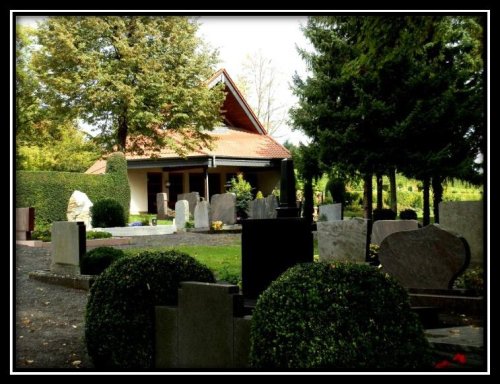

In 1988, the current funeral hall decorated with windows designed and made by Stefan Gassner ("glass artist" from Spiesheim) was opened and the area next to the building laid out as extension of the graveyard. At that time, the funeral processions starting from the home of the deceased came to an end.
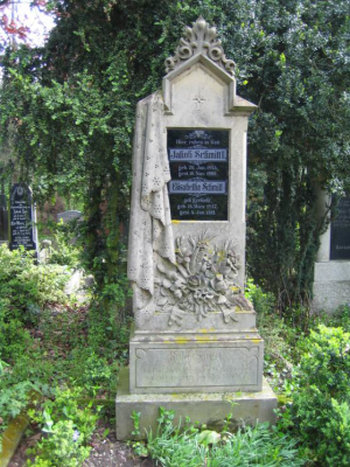
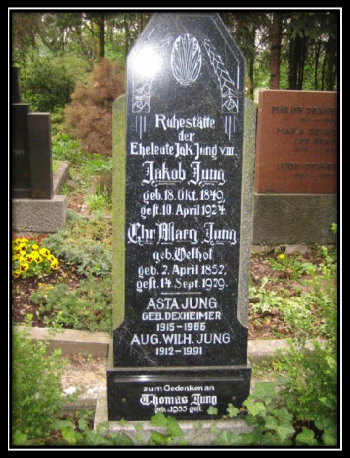
Old tombstones dating from the early period of the graveyard were kept for a long time. During the last years, they had to be taken down either due to unsoundness or because no relatives remained to take care of them. So, sad to say, there are no more memorial stones left that date from that time. However, Ingolf Jung took at least some photos of several nice old tombstones, as shown here.
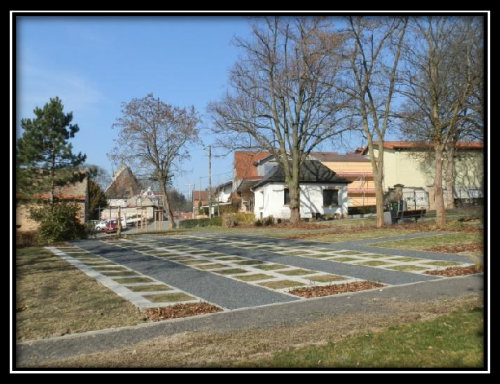
Since the rearrangement of the old burial ground and the part on the right side behind the entrance in 2015, rows for urns from cremations have been provided.
Text 26: Sigmund Jung October 2016
Translation: Hildegard Wingert
Pictures: Erich Dexheimer / Ingolf Jung
Historischer Ortsrundgang Spiesheim
Friedhof und Bestattungswesen
Der Friedhof mit seinen Grabplätzen als letzte Ruhestätte der Verstorbenen ist in vielen Kulturen ein Ort, um den Angehörigen ungestörtes Totengedenken in einem Raum zu ermöglichen, der deutlich von dem der Lebenden abgetrennt ist. In Deutschland gilt Bestattungspflicht für Verstorbene und tot Geborene in dafür ausgewiesenen Orten.
Somit spielt der Friedhof eine wichtige Rolle in der religiösen Praxis und erfüllt auch öffentliche Interessen.
Diese gesellschaftliche und religiöse Bedeutung des Friedhofs hat eine Vielzahl an Tabus, moralischen Pflichten und Gesetzen hervorgebracht. Die Verletzung der Regeln oder die Entweihung ist von der jeweiligen Gemeinschaft unter Strafe gestellt. Praktisch in allen Kulturen sind die Störung der Totenruhe, die Leichenschändung, die Grabschändung und der Grabraub strafbar. Derartige Handlungen werden in Deutschland strafrechtlich verfolgt.
In der Antike und Völkerwanderungszeit ließen sich die Germanen auf dem Gebiet des heutigen Deutschlands verbrennen oder beerdigen.
Mit Ausbreitung des Christentums wurde die Feuerbestattung verboten. Die Gläubigen wurden in Anlehnung an die Geschichte Jesus Christus in der Erde bestattet. Erst Ende des 19. Jahrhundert wurden wieder Feuerbestattungen zugelassen.
Die Bestattung der Toten hatte im Mittelalter eine sehr kirchliche Prägung. Sie erfolgte meist noch am Tag des Todes und unter gewissen Formalitäten, die dem Stand des/r Verstorbenen entsprechend sehr unterschiedlich waren: Gewöhnliche Menschen wurden ohne Sarg auf einem Brett liegend bestattet und in den Kleidern, in denen sie gestorben waren, der Erde übergeben. Vornehmere Menschen wurden im Sarg beigesetzt, der bis ins 14. Jahrhundert auch mal aus Stein bestand. Der/die Tote wurde von seinen/ihren Angehörigen zu Grabe getragen.
Begräbnisstätten aus mittelalterlicher Zeit haben sich in Deutschland nicht erhalten. Wie landläufig üblich wurden sie um die katholische Kirche herum angeordnet, so auch in Spiesheim. Deshalb wird auch heute noch der Friedhof im Sprachgebrauch als "Kirchhof" bezeichnet. Ab Anfang des 16. Jahrhunderts wurden diese Begräbnisstätten wegen zunehmendem Platzmangel und Seuchengefahr von den Kirchen weg an den Dorfrand verlegt. In vielen Dörfern hat sich die Anlage bis auf den heutigen Tag an derselben Stelle erhalten. Dies gilt auch für den Spiesheimer Friedhof, der 1833 eingeweiht wurde.
Seit dieser Zeit wurden die Verstorbenen im Trauerhaus eingesargt und am Tag der Beerdigung im Hof aufgebahrt. Nach der Aussegnung durch den Pfarrer und ggf. einem Abschiedslied des Gesangvereins oder Musikgruppe wurde der Sarg auf einen Leichenwagen gehoben. Geschmückt mit Blumen und Kränzen und begleitet von einer meist großen Trauergemeinde setzte sich der Trauerzug in Bewegung. Fast von jedem Haus "ging jemand mit". Ein Pferd mit schwarzer Trauerdecke zog den Leichenwagen zum Friedhof.
Gräber wurden mit der Hand ausgehoben. Besonders im Winter bei gefrorenem Boden war dies eine mühsame Arbeit die in Spiesheim bis in die späten 1980er Jahre ausgeführt wurde.
Bei starkem Regen musste öfters die nachgerutschte Erde aus dem Grab entfernt werden und es kam schon mal vor, dass der Totengräber noch aus dem Grab guckte, wenn der Leichenzug schon auf dem Weg zur letzten Ruhestätte war.
Nach der Beisetzung des/r Verstorbenen durch den Pfarrer, ggf. umrahmt von Grabgesang oder Instrumentalmusik, folgte das Requiem bzw. der Trauergottesdienst in der Kirche, wie noch heute üblich. Das sich anschließende besinnliche Beisammensein mit Kaffee und Kuchen, "Leichenimbs" genannt, wurde meist im Haus des/r Verstorbenen abgehalten und diente der gemeinsamen Erinnerung an den Verstorbenen/an die Verstorbene sowie der Trauerbewältigung der Hinterbliebenen. Dieser Brauch ist auch heute noch in Spiesheim üblich, findet aber sehr oft in Gaststätten oder der Gemeindehalle statt.
Mit zunehmendem Einsatz von Automobilen wurde der Pferdewagen im Jahr 1965 abgelöst. Noch heute existiert das in der Friedhofsfront rechts stehende kleine Häuschen, in dem der Pferdewagen stets abgestellt war.
Die jetzige Aussegnungshalle wurde 1988, ausgestattet mit Gassner-Kunst, ihrer Bestimmung übergeben und das Gelände neben dem Gebäude als Friedhofserweiterung angelegt. In dieser Zeit wurden auch die vom Trauerhaus ausgehenden Beerdigungen eingestellt.
Lange Zeit blieben alte Grabsteine aus der Anfangszeit des Friedhofes erhalten, mussten aber in den letzten Jahren wegen Baufälligkeit oder nicht mehr existierenden und für die Erhaltung zuständigen Angehörigen, abgebaut werden. So sind nun leider keine Gedenksteine aus dieser Zeit mehr vorhanden. Ingolf Jung hat jedoch noch etliche schöne alte Grabsteine zumindest fotografiert, wie hier gezeigt.
Seit einer Bereinigung von alten Grabfeldern und Reorganisation der vorderen rechten Friedhofspartie in 2015 gibt es nun auch in Spiesheim Grabreihen für Urnen aus Feuerbestattungen.
Text 26: Sigmund Jung Oktober - 2016
Bilder: Erich Dexheimer / Ingolf Jung
Tour of Spiesheim's History
The "Zappe" of Spiesheim
(The spigot of Spiesheim)
A true story about gullibility and superstition still reigning at the beginning of the 19th century helped people in Spiesheim to their nickname. In July 1804, Peter Fuchs married a young woman from Spiesheim and lived in this house from that day on.
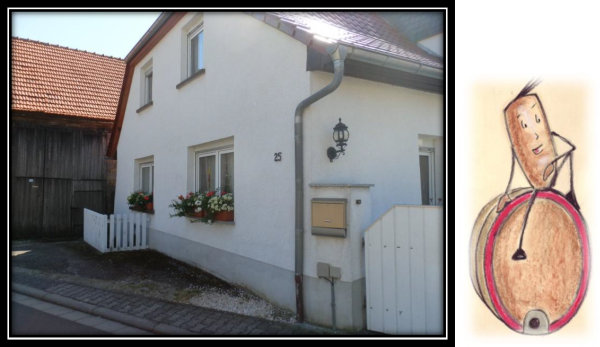
In 1769, Fuchs was born in Offenbach/Main as son of a knacker (responsible for the carcass disposal in a certain district). He posed as graduated veterinary, or maybe he just had a good knowledge of veterinary medicine. No records of that time could clarify this. However, there was a "Doctor" in the village now who took care of the farmers' ill cattle. People thought highly of him and even attributed supernatural power to him. When a head of livestock was ill, "Doctor" Fuchs was called. He knew a good many remedies to help the ill creature; he talked to it, rubbed its belly, and he often was successful with his "cure". Whether the consistently meagre reward made him help to accelerate success a bit or if other circumstances were the reason will never be clarified.
As it turned out much later, Mr. Fuchs began to cheat his innocent fellow citizens.
While the farmers were working on the fields, he sneaked into yards and cowsheds and milked some cows at unusual times. In the evening, the farmers were horrified to see that their cows gave little or no milk and, assuming their cows were ill, called for "Doctor" Fuchs. The latter clearly diagnosed the curse of a witch and offered to lift it, against being rewarded with money or in kind, of course. As the farmers wanted their cows to be freed from the witch's curse they accepted. Fuchs got down to work, stroked the "bewitched" cows, murmured some magic spells and, last but not least, hit a wooden spigot ("Zappe") into the wall of the cowshed. Additionally, he promised that the cow would be freed from the curse the next morning and give milk as usual. Of course, that happened, and so he received the promised reward of the farmers who believed in the effect of the magic spells. In the course of time, he acquired a good reputation. He was up to mischief in nearly every cowshed in Spiesheim.
As so often, "the pitcher goes often to the well and gets broken at last". Having become suspicious through so many successfully banished witches, some younger farmers watched their cowsheds and caught the "doctor" when he secretly milked the cows again. He got a sound thrashing and, additionally, the then mayor Wagner reported Mr. Fuchs to the police in Wörrstadt. Fuchs had to serve a prison sentence and was never seen again in Spiesheim.
As this story quickly spread more and more around in neighbouring villages, ever since then, people living in Spiesheim have been nicknamed:
"Die Zappe - The Spigots".
The "Song of Spiesheim" summarises this story with the following verse:
"Es war en Mann mit Name Fuchs,
der hot die ganz Gemo beluchst.
Er schlug en Zappe in die Wand
und sagt, er hätt´ die Hex´ gebannt"
This is to say in English:
Mr. Fuchs cheated the whole village:
With a spigot in the wall
he said he'd banished the witch.
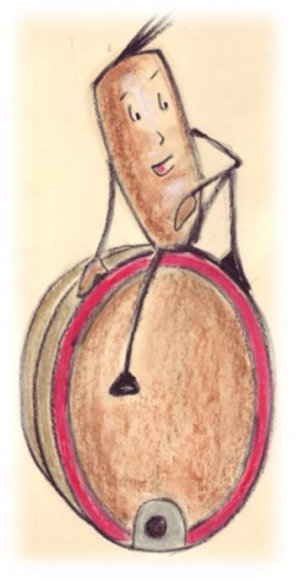
This is a modern illustration of the "Spigot" displayed on all signs of the "Tour of Spiesheim's History".
Text L 16: Sigmund Jung October 2016
Translation: Hildegard Wingert
Picture: Erich Dexheimer
Logo: Agentur Franzen
| Letzte Änderungen |
|---|
| Nächste Termine | |||||||
|---|---|---|---|---|---|---|---|
|